Another week in second grade is in the books, and as I sit and reflect on our days together, I find myself thinking about something that happens so often in an elementary classroom:
Children begin to see the world a little differently.
Sometimes it happens because of a conversation.
Sometimes it happens when a child suddenly understands something that seemed confusing the day before.
And sometimes it happens when they are given a ruler, a pencil, a piece of paper, and the opportunity to figure something out for themselves.
This week, we did a little bit of all of that.
Words That Help Us Connect
During our English Language Development block, we worked with transition words.
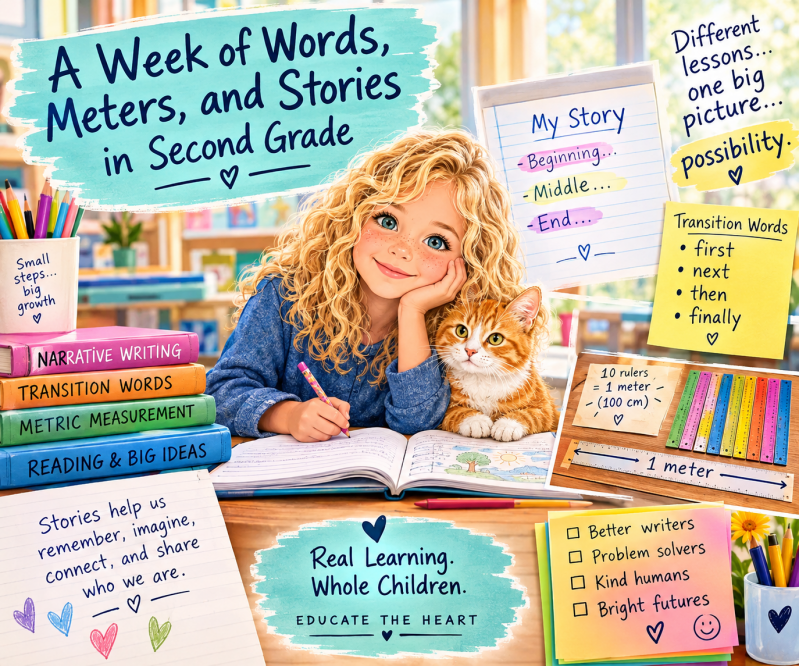
We talked about words such as first, next, then, and finally and how these little words help us connect our ideas and guide our readers through our thinking.
I love these kinds of lessons because transition words can seem so small, yet they make such a big difference.
My students are becoming writers who are beginning to understand that writing isn't just about getting words onto a piece of paper.
We want our readers to understand us.
We want our ideas to connect.
We want our writing to sound like it makes sense.
And that means the words we choose matter.
I found myself listening to students use these words throughout the week, sometimes without even realizing that they were applying what we had learned. Those little moments are the ones that make a teacher smile.
Building a Meter
Math was very hands-on this week as we continued learning about the metric system.
One of my favorite activities was creating our own meter sticks.
We used ten 10-centimeter rulers and put them together to create one meter.
I watched little hands carefully line up the rulers, check their work, and talk about what they were noticing.
Ten centimeters.
Another ten.
And another.
Until suddenly, we had a meter.
I love when math becomes something children can actually see and touch.
There is a difference between telling a child that one meter is 100 centimeters and allowing that child to physically build one.
They weren't just learning about measurement.
They were experiencing it.
And there was plenty of conversation along the way—which, to me, is another important part of learning.
Finding Our Stories
This week, we also began focusing on narrative writing.
There is something special about asking children to tell a story.
Second graders have so many stories inside of them.
Some are big.
Some are small.
Some are completely true.
And some begin with a little bit of imagination.
We talked about how narratives have a beginning, middle, and end and how writers can use details to help their readers picture what is happening.
We thought about what happens first, what happens next, and what happens finally.
And suddenly, those transition words we had been practicing had a purpose.
They weren't just words on a list.
They became tools that could help us tell our stories.
I love watching children discover that writing is more than simply answering a question.
Writing can be a way to share an experience.
It can be a way to remember something important.
It can be a way to make someone laugh.
It can be a way to describe a moment that made us happy, nervous, excited, surprised, or proud.
As my students began working on their narratives, I found myself asking questions that encouraged them to add more to their stories.
What happened next?
What were you thinking?
How did you feel?
What did you see?
What did the person in your story say?
Those questions may seem simple, but they help children understand that details bring writing to life.
A story becomes much more interesting when the reader can step inside it.
And perhaps my favorite part is seeing the different stories that emerge from the same classroom.
Every child has a different experience.
Every child notices different things.
Every child has a different voice.
That is one of the beautiful things about teaching writing.
There isn't just one story.
There are dozens of stories sitting at desks around the room, waiting to be told.
When Learning Connects
One of the things I love most about teaching is when different parts of our learning begin to connect.
Our work with transition words became part of our narrative writing.
Our conversations became part of our writing.
Our experiences became ideas.
And our ideas became stories.
This is when learning begins to feel less like separate subjects and more like one big experience.
Math gives us opportunities to explore.
Reading gives us ideas.
Language gives us ways to communicate.
Writing gives us a place to put those ideas.
And somewhere in the middle of all of it, children begin to discover more about themselves.
The Little Moments
When I think back over the week, I don't think I will remember every worksheet we completed or every page in our books.
I will remember the little moments.
The children carefully putting their rulers together.
The excitement when they realized they had created a meter.
The student who remembered to use a transition word.
The child who suddenly realized that adding one more detail could make a story more interesting.
The student who couldn't wait to share what happened next in their narrative.
The conversations happening around the room as children tried to put their experiences into words.
Those are the moments that remind me why I love teaching.
After almost three decades in education, I still find myself amazed by the way children learn.
They are curious.
They are funny.
They are wonderfully unpredictable.
And they remind me that learning doesn't have to be perfect to be meaningful.
Educating the Heart
This is one of the reasons I wrote Educate the Heart.
For me, education has never been only about standards, assessments, grades, or academic achievement.
Of course, those things matter.
But so does curiosity.
So does confidence.
So does perseverance.
So does learning to listen to another person's ideas.
So does finding the courage to put your own ideas into words.
That is what I hope we are building in our classroom every day.
We are learning mathematics and language and reading and writing.
But we are also learning how to think.
How to wonder.
How to create.
How to communicate.
And how to believe that our voices matter.
This week, my second graders measured centimeters, built meters, connected ideas with transition words, and began discovering the power of telling their own stories.
It may have looked like a typical week of second grade from the outside.
But from inside Room 214, it felt like so much more.
It felt like possibility.
And that is always my favorite kind of learning.
Thank you for visiting the blog. I hope you found this post worthwhile.
With gratitude,
Jennifer
Add comment
Comments