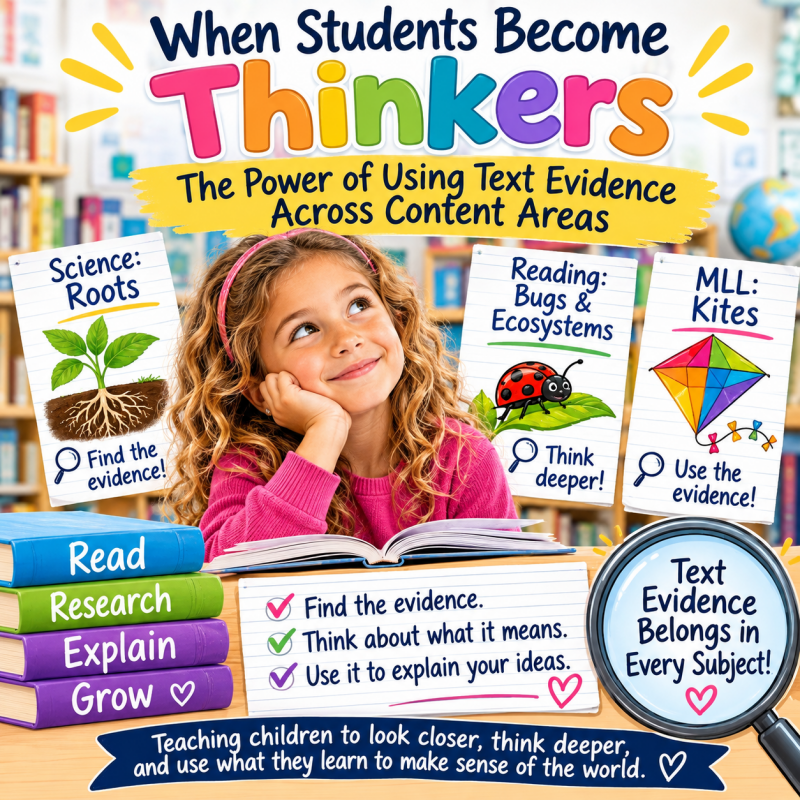
Teaching children to look closer, think deeper, and use what they learn to make sense of the world.
Some weeks in the classroom remind me just how exciting learning can be when children begin to see themselves not simply as readers, writers, or students, but as thinkers, researchers, and problem-solvers.
This week in our second-grade classroom, we spent time learning how to use text evidence across content areas. What I loved most was watching students begin to understand that the information they read isn't just something to remember or repeat. It is something they can use to develop their own ideas, explain their thinking, and support what they believe.
And the excitement that comes with that discovery is something special!
Throughout the week, we explored several different topics, each giving students another opportunity to practice finding information, looking closely at details, and using evidence to support their thinking.
In science, we researched root systems and learned how roots help plants survive. Students explored informational text, identified important details, and used what they learned to explain why roots are so important.
During reading, our focus shifted to bugs and their ecosystems. As we read and explored informational texts, students began making connections between the insects themselves and the environments in which they live. They were learning to look beyond the words on the page and think about what the information actually tells us.
During our MLL block, we explored kites. Students used informational text to gather details, build vocabulary, and share what they discovered. This provided another meaningful opportunity to practice using evidence while developing language and confidence in expressing ideas.
Although our topics were different, the learning goal remained the same: Find the evidence. Think about what it means. Use it to explain your ideas.
From Finding Answers to Forming Ideas
One of the most rewarding parts of this week was seeing students become increasingly excited about sharing their thinking.
Instead of simply asking, "What did you learn?" we began asking questions such as:
- What makes you think that?
- Where did you find that information?
- Which detail from the text supports your idea?
- Can you explain your thinking using evidence?
These questions encourage children to slow down, look back at the text, and recognize that their ideas have value when they can support them with information.
For young learners, this is an important shift. We want children to understand that reading informational text is about more than locating an answer. It is about developing curiosity, making connections, and learning how to explain why they think something.
There is something wonderful about watching a second grader return to a page, point to a sentence or detail, and proudly announce, "I know because the text says..."
That is learning in action!
The Bigger Picture
As a former elementary principal and kindergarten teacher, I have always believed that meaningful learning happens when children are given opportunities to make connections. The skills we teach should never feel isolated to one subject or one lesson.
Text evidence isn't just a reading skill. It is a tool students can carry with them into science, social studies, writing, conversations, and everyday life.
When we teach children to look for information, question what they read, and support their thinking, we are helping them develop skills that extend far beyond the classroom.
We are also giving our multilingual learners meaningful opportunities to build academic vocabulary, practice language, and participate in conversations where their ideas matter.
And perhaps my favorite part of the week was realizing how naturally these conversations began to happen. Students were eager to share what they had discovered, explain their reasoning, and listen to the ideas of their classmates.
They weren't just looking for the right answer anymore. They were beginning to understand that they could use what they learned to form their own ideas.
That is the kind of learning I hope stays with them long after the lesson is over.
Because ultimately, our goal isn't simply to teach children what to think. It is to help them learn how to think.
And sometimes, the most meaningful classroom moments happen when a child looks back at a book, finds the evidence, and realizes that they have something important to say.
Little learners. Big ideas. Growing thinkers. Every single day.
With gratitude,
Jennifer
Add comment
Comments