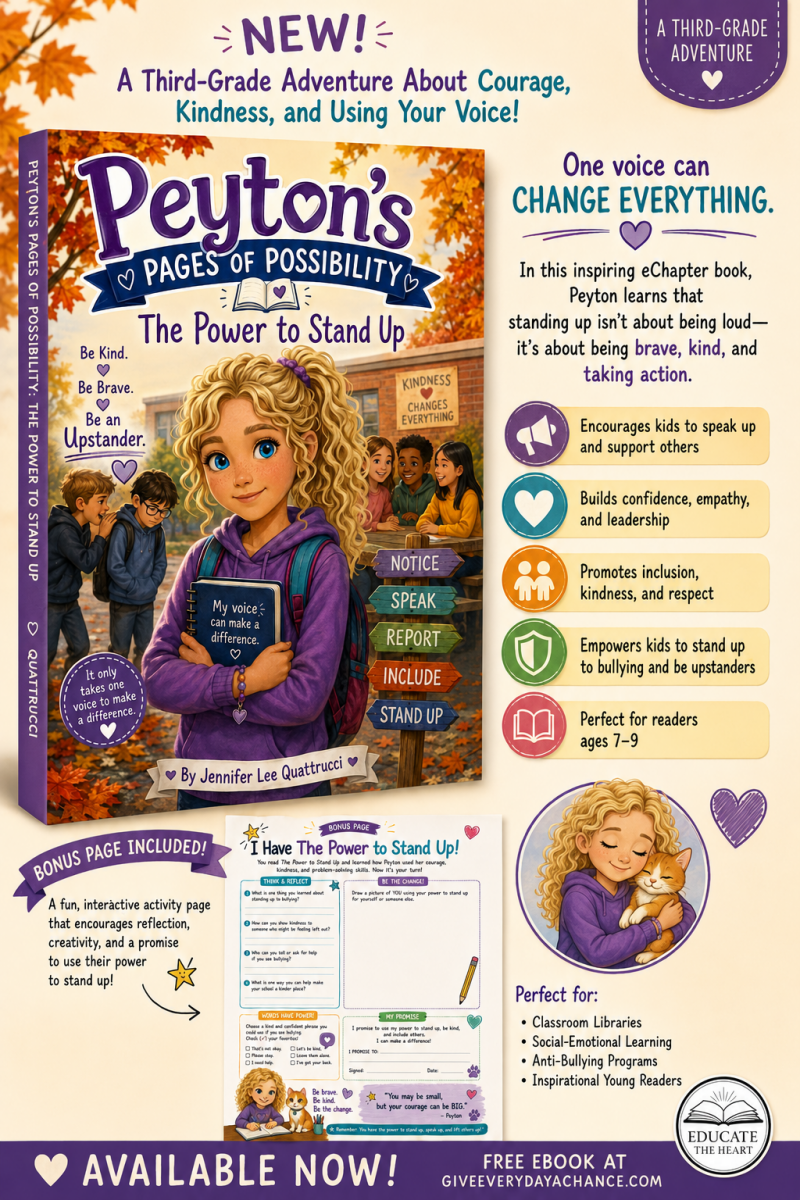
I wrote Peyton's Pages of Possibility: The Power to Stand Up because I wanted to give children language for moments that often feel confusing, quiet, and deeply important.
As adults, we know that childhood is full of learning that never appears on a spelling test or a math worksheet. Kids are constantly trying to figure out friendships, fairness, belonging, courage, and what to do when they see someone being hurt. Those situations can be complicated even for grown-ups, so for children they can feel especially overwhelming. I wrote this book to help young readers understand that they do not have to have all the answers immediately - but they can learn how to notice, think, and respond with kindness and courage.
At the heart of Peyton's story is a question many children wrestle with: What should I do if something doesn't feel right?When a classmate is teased, excluded, or repeatedly targeted, children often hesitate. They may wonder whether they should speak up, whether telling an adult is tattling, or whether it is safer to stay out of it because the situation is not happening directly to them. I wanted to explore those questions honestly, in a way that feels accessible and age-appropriate, without talking down to children or oversimplifying the emotional weight of those moments.
This book is meant to teach that not all hurtful behavior is the same. One of the most important lessons in the story is helping children understand the difference between rude behavior, mean behavior, and bullying. Kids hear those words often, but they are not always given clear, usable definitions. By showing Peyton learning those distinctions in her classroom, I hoped to give readers a framework they can actually remember and apply in real life.
I also wrote this book to teach the difference between tattling and reporting. That is such a powerful distinction for children. Many kids stay silent, not because they do not care, but because they are afraid of getting someone in trouble or being seen as a tattletale. I wanted readers to come away knowing that when someone may be unsafe, repeatedly targeted, threatened, or hurt, getting help is not tattling - it is caring. It is brave. It is responsible.
Another message that mattered deeply to me is that being an upstander does not always look dramatic. Standing up for someone is not always loud. It does not always mean confrontation. Sometimes it means saying, "That's not okay." Sometimes it means refusing to laugh. Sometimes it means getting a trusted adult. And sometimes it means doing something as simple and powerful as saying, "Come sit with us." I wanted children to see that courage can be quiet, thoughtful, and safe.
The book also explores the lasting impact of words. The Crumpled Paper Activity became an important part of Peyton's journey because it offers such a tangible way for children to understand emotional harm. Apologies matter, of course. Repair matters. But words can leave marks, and children need help understanding both the responsibility of their own words and the importance of using those words to heal, include, and protect.
More than anything, I wrote this story to encourage empathy. I want young readers to notice the child who looks down, walks away, gets quiet, or sits alone. I want them to understand that kindness is not just about being nice when everything is easy. Sometimes kindness asks something of us. Sometimes it asks us to be uncomfortable. Sometimes it asks us to act.
For parents, teachers, counselors, and caregivers, my hope is that this book opens meaningful conversations. I hope it gives adults a gentle way to talk with children about bullying, peer behavior, inclusion, and safety. And for kids, I hope it offers reassurance: you do not have to be the loudest person in the room to make a difference. You do not have to be fearless to be brave. You just have to be willing to care and to act in a safe, thoughtful way.
Peyton's journey is really about discovering that one voice matters. That one kind choice matters. That one brave moment can change someone else's day - and sometimes much more than that.
That is what I hope this book teaches: Be kind. Be brave. Be an upstander. Because one voice really can make a difference.
FIND it HERE!
With gratitude,
Jennifer
Add comment
Comments