In the middle of a busy kindergarten day—between phonics lessons, math centers, gym class, and learning how to share the blue crayon—something magical happened in our classroom this week.
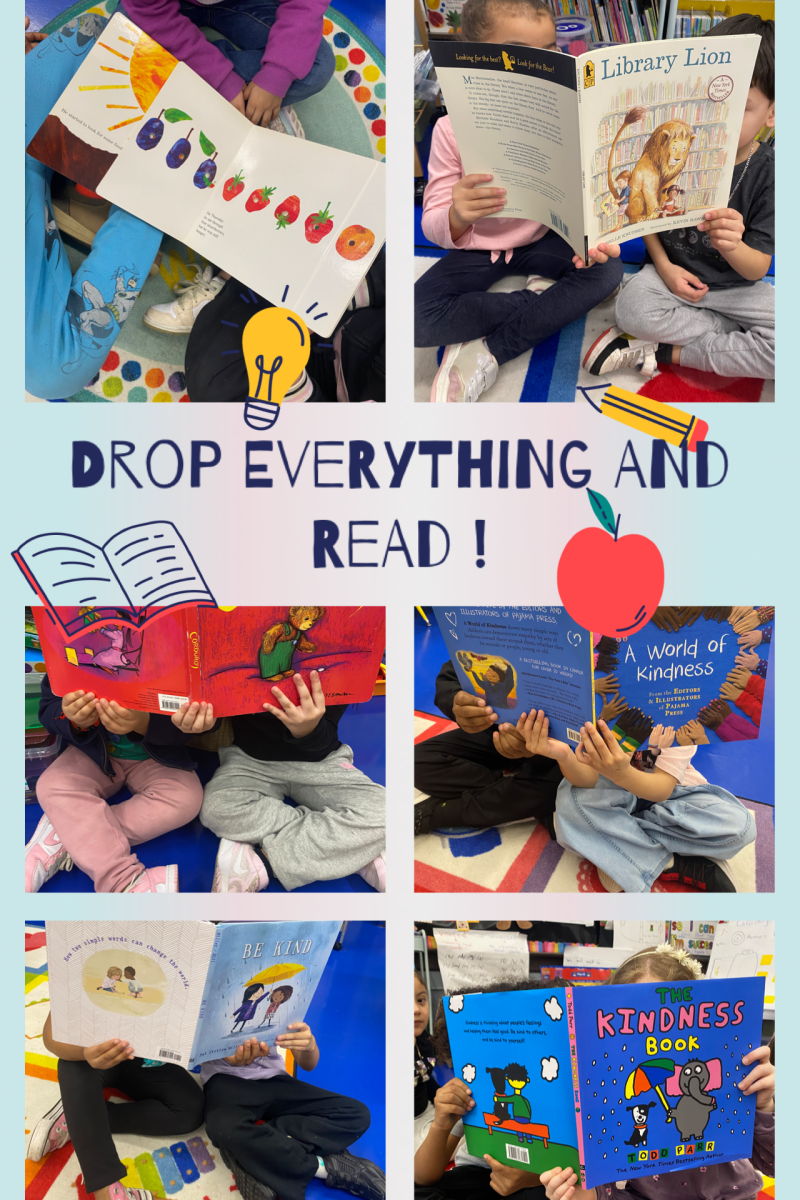
For fifteen minutes, we practiced DEAR: Drop Everything and Read.
And I wish we could do it every day.
As a kindergarten teacher in a classroom filled with Multilingual Learners, I am always thinking about how to build language, confidence, and belonging. We work hard on letters and sounds. We practice vocabulary. We sing songs and act out stories.
But during DEAR time, something different happened.
Everything slowed down.
Children curled up with books like old friends. Some lay on their stomachs, kicking their feet in the air. Others leaned against a bookshelf or nestled next to a classmate. Pages turned slowly and carefully.
The room felt peaceful.
And joyful.
For many of my students, books are still a developing language. They are learning English while also learning how stories work—how pictures tell meaning, how characters feel, how words connect to the world around them.
But stories don’t require perfect English to be understood.
Pictures speak.
Expressions speak.
Kindness speaks.
I noticed several children gravitating toward familiar favorites like Corduroy by Don Freeman. The simple story of a little bear searching for his missing button—and finding a home—seemed to resonate deeply. My students studied the illustrations closely, pointing out Corduroy’s adventures in the department store.
Others eagerly reached for The Very Hungry Caterpillar by Eric Carle, tracing the tiny holes in the pages with their fingers as the caterpillar munched his way through apples, pears, and plums. Even students who are still developing English vocabulary could follow the rhythm of the story through the pictures.
Another group gathered around Library Lion by Michelle Knudsen, giggling softly at the idea of a lion quietly walking through a library. The story sparked whispers of conversation about rules, kindness, and helping others.
And that was the most beautiful part.
Many of the books students chose centered around kindness—stories about helping, sharing, and being a good friend. These themes cross every language barrier. Whether a child speaks Spanish, Portuguese, Arabic, or English, the idea of kindness is universal.
You could feel it in the room.
As a former principal and the author of Educate the Heart, I have always believed that literacy is not just about decoding words.
It is about educating the heart.
Reading helps children develop empathy. When they step into a story, they step into someone else’s experience. They begin to understand feelings, fairness, friendship, and courage.
Those are lessons that stay with them long after they learn to read fluently.
What struck me most during those fifteen minutes was the pure joy on my students’ faces. No one was rushing. No one was asking, “What do I have to do next?”
They were simply enjoying books.
In a world where instructional minutes are carefully scheduled and every moment is accounted for, it reminded me how powerful it is to make space for reading simply for the love of reading.
Imagine if every classroom had fifteen minutes a day—or even once a week—where children could just drop everything and read.
No worksheet.
No assignment.
Just stories.
Sometimes the smallest moments in a classroom become the most meaningful ones. For my students, those fifteen minutes were more than a break in the schedule.
They were a window into imagination, language, and kindness.
And judging by the smiles in our classroom, those pages were doing exactly what books are meant to do.
They were opening hearts.
Thank you so much for visiting my blog and taking the time to read this post. I hope you found it worthwhile!
Best,
Jennifer
Add comment
Comments