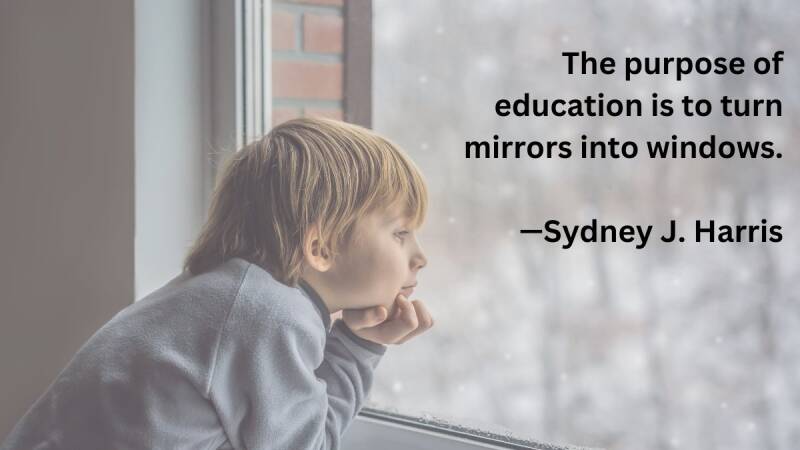
“The whole purpose of education is to turn mirrors into windows.”
— Sydney J. Harris
This quote stayed with me all week.
As a kindergarten MLL teacher, a mom of two, a former elementary principal, and the author of Educate the Heart, I often reflect on what education is truly meant to do. Yes, we teach letters, numbers, sounds, and patterns. We celebrate sight words and count to 100.
But if we stop there, we’ve missed the deeper purpose.
This week in my classroom, I watched education do something more meaningful. I watched it begin to turn mirrors into windows.
Young children naturally start by seeing the world through mirrors. That’s developmentally appropriate. Five- and six-year-olds are still discovering who they are—what feels familiar, what makes sense in their world, what reflects their own experiences.
A mirror shows us ourselves.
But education—real education—gently opens the window.
This week, during classroom conversations and shared stories, I saw that shift beginning to happen. One student shared a tradition his family celebrates at home. Another child listened and said thoughtfully, “That’s different from my house.” What followed wasn’t confusion or judgment, but curiosity. Questions. Interest.
A window had opened.
Later, a student quietly helped translate for a classmate searching for the right word in English. She leaned over, offered the word, and helped him share his idea. It wasn’t about showing what she knew—it was about helping someone else be heard.
Another window.
Moments like these remind me why I wrote Educate the Heart. Education is not only about helping children reflect on their own experiences. It’s about helping them see beyond them.
Mirrors help children feel seen, valued, and proud of who they are.
Windows help them understand the lives, languages, and experiences of others.
In a multilingual kindergarten classroom, those windows open naturally—when children hear different languages, learn about each other’s traditions, and realize that families can celebrate, speak, and live in beautifully different ways.
As a mom of a 16- and 20-year-old, I’ve learned the same lesson at home. Some of our most meaningful conversations over the years have been about perspective—about noticing the world beyond our own experiences and learning to approach it with empathy and curiosity.
Those conversations are windows, too.
And as a former principal, I’ve seen that the healthiest school communities intentionally build both mirrors and windows—through literature, art, conversations, and the way adults model respect and compassion.
This week reminded me that even in a kindergarten classroom, those windows are already opening.
In small comments.
In shared stories.
In quiet acts of kindness.
Education, at its best, helps children see themselves clearly—and then invites them to look outward with curiosity, empathy, and wonder.
That is the work.
Turning mirrors into windows, one small moment at a time.
Thank you for visiting the blog and taking the time to read this post. I hope you found it worthwhile.
Best,
Jennifer
Add comment
Comments