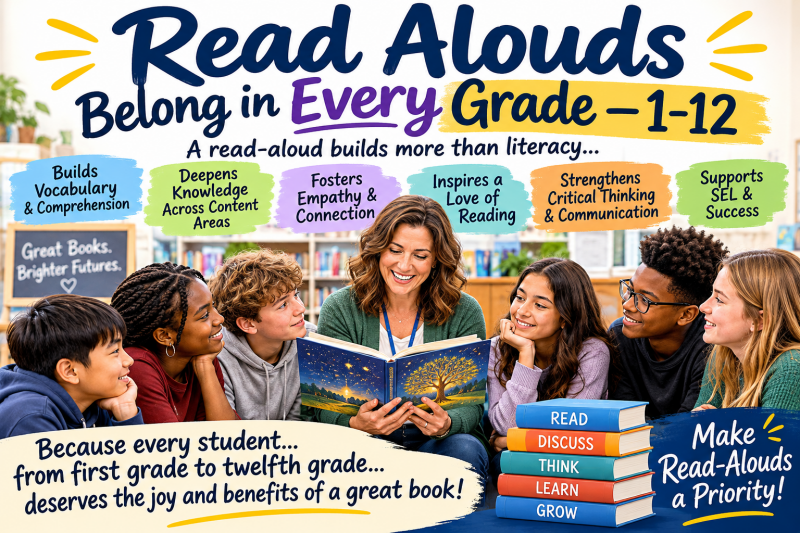
Some of the most powerful learning experiences in a classroom begin when a teacher opens a book and reads the first sentence aloud.
There is something almost magical about a read-aloud.
A classroom becomes quiet—not necessarily because every child is sitting perfectly still, but because a story has captured their attention. They begin wondering, predicting, laughing, questioning, imagining, connecting, and sometimes even seeing themselves in a character for the very first time.
As educators, we know the power of books. But somewhere along the way, in the increasingly crowded world of standards, pacing guides, scripted programs, assessments, and curriculum mandates, the read-aloud can become something we squeeze in when we have time.
And that is precisely the problem.
Reading aloud should not be considered an extra, a reward, a Friday activity, or something reserved exclusively for primary grades. It should be a purposeful, research-supported component of instruction in every grade, from kindergarten through twelfth grade.
And if teachers are expected to follow prescribed curriculum with little flexibility to "stray" from the materials, then read-alouds need to be built directly into the curriculum itself—with intentional planning, standards alignment, meaningful extensions, and instructional purpose.
Not added as an afterthought.
Not left to chance.
But embedded in the curriculum.
What the research tells us
The benefits of reading aloud are not simply sentimental or anecdotal. Research supports the use of read-alouds to strengthen language development, vocabulary, comprehension, motivation, and access to complex ideas.
Vocabulary and comprehension grow through listening to rich language
A 2002 study published in the Journal of Educational Psychology examined read-aloud approaches with first- and third-grade students. Researchers found statistically significant effects on vocabulary acquisition and comprehension, with interactive reading particularly beneficial for vocabulary learning.
Children don't need to independently decode every word in a book to benefit from sophisticated vocabulary, meaningful sentence structures, figurative language, and ideas that stretch their thinking.
A teacher reading aloud creates an opportunity for children to hear language beyond what they may encounter in their independent reading.
Reading aloud supports comprehension across content areas
Research from Brown University's Annenberg Institute examined structured read-aloud supplements connected to content-rich curriculum. Students receiving the structured supplements performed better on multiple measures of domain-specific reading comprehension, demonstrating the value of intentionally connecting background knowledge, teacher explanations, vocabulary, and discussion to a read-aloud.
This is especially important because a read-aloud does not need to be limited to ELA.
A story can introduce a science concept. A biography can connect to social studies. A poem can deepen understanding of figurative language. A picture book can launch an argument, a research project, a mathematical discussion, or a reflection on character.
Students in the middle grades benefit from shared reading experiences, too
Research examining shared reading aloud through cluster-randomized trials in elementary and middle school settings found positive effects on two measures of intelligence compared with continuing regular instructional activities. This is a reminder that shared reading experiences are not developmentally outgrown when children leave the primary grades.
Middle school students still need opportunities to build background knowledge, encounter unfamiliar language, discuss complex ideas, and engage with literature in ways that do not always require the pressure of independently decoding every sentence.
Adolescents still need literacy support
A systematic review and meta-analysis published in 2026 examined 106 studies involving 156,981 students in Grades 4–12 who experienced or were at risk of reading difficulties. Reading interventions had a positive overall effect, with vocabulary-focused interventions among the most effective. Benefits were found across grades and settings, including for multilingual learners and students with learning disabilities.
This research does not mean every benefit can be attributed exclusively to read-alouds. It does reinforce an important point: literacy development does not stop in elementary school, and older students continue to need intentional instruction in vocabulary, comprehension, and language.
Read-alouds can help cultivate a culture of readers
A synthesis of research on secondary English classrooms found that most of the studies reviewed suggested read-alouds positively influenced students' attitudes toward reading, although the research also identified limitations and the need for further studies.
That matters.
Students who struggle with reading may begin to associate books with frustration, embarrassment, or failure. A teacher reading a compelling passage aloud can provide a shared experience in which everyone has access to the story, the humor, the emotion, and the ideas.
Sometimes a child who insists, "I don't like reading," simply hasn't yet encountered the book that changes their mind.
And sometimes that book finds them because a teacher reads it aloud.
The read-aloud belongs in every grade: Grades 1–12
The books change as students grow. The purpose doesn't disappear.
Grade 1: The Day the Crayons Quit — Drew Daywalt
ELA | Opinion writing | Perspective
Explore character feelings, letter writing, point of view, adjectives, and persuasive language. Students write a letter from an object in their classroom explaining what it wishes their teacher understood.
Grade 2: The Invisible Boy — Trudy Ludwig
SEL | Character analysis | Evidence
Identify how Brian feels at the beginning and end of the story. Use evidence to explain how small acts of kindness change his experience. Extend into a kindness journal, classroom community discussion, or letter to a character.
Grade 3: The One and Only Ivan — Katherine Applegate
ELA | Science | Animal habitats
Explore point of view, character change, animal habitats, and human responsibility. Students compare fictional Ivan with nonfiction sources about gorillas and create an informational report.
Grade 4: Wonder — R. J. Palacio
SEL | Perspective | Narrative
Compare perspectives of different characters, analyze how point of view shapes events, explore belonging and empathy, and write a narrative from another character's perspective.
Grade 5: Number the Stars — Lois Lowry
Social studies | Historical fiction | Courage
Connect the novel to World War II, the Holocaust, resistance, and Denmark's rescue of Jewish people. Students examine historical context, distinguish fact from fiction, and discuss courage and moral choices.
Grade 6: The Giver — Lois Lowry
ELA | Ethics | Society
Explore symbolism, dystopian societies, memory, freedom, and the role of rules. Students debate whether a society can be safe without freedom and support arguments with textual evidence.
Grade 7: The Outsiders — S. E. Hinton
ELA | Identity | Social issues
Explore identity, stereotypes, social class, belonging, and conflict. Students analyze character motivations, compare social groups, write theme statements, and discuss how assumptions influence relationships.
Grade 8: The Diary of a Young Girl — Anne Frank
History | ELA | Primary sources
Use selected passages to study perspective, voice, historical context, and the power of primary sources. Compare diary excerpts with historical documents and reflect on the role of personal testimony.
Grade 9: The Hate U Give — Angie Thomas
ELA | Media literacy | Civic discourse
Examine voice, code-switching, identity, media representation, and perspective. Analyze how different sources frame an event and practice evidence-based discussion. Review content, school policy, and maturity appropriateness before selecting.
Grade 10: The Book Thief — Markus Zusak
ELA | History | Literary analysis
Analyze narration, symbolism, figurative language, theme, and the impact of word choice. Pair excerpts with historical research and examine how literature communicates the human experience of war.
Grade 11: The Immortal Life of Henrietta Lacks — Rebecca Skloot
Biology | Ethics | Research literacy
Explore cells, medical research, informed consent, bioethics, and inequities in healthcare. Students evaluate claims, analyze source credibility, and develop evidence-based arguments. Select excerpts with attention to mature subject matter.
Grade 12: Born a Crime — Trevor Noah
ELA | History | Sociology | Identity
Study memoir, humor, voice, culture, apartheid, identity, and resilience. Students analyze how personal narrative communicates larger social and historical realities, then write their own reflective memoir or develop a research-supported discussion. Use the young readers' edition or carefully selected excerpts as appropriate.
These are examples, not a prescribed book list. Titles can be adapted, replaced, or paired with shorter texts based on students, community, school policies, curricular goals, and age appropriateness.
The important thing is that every grade has thoughtfully chosen texts worth hearing.
What a purposeful read-aloud looks like inside a curriculum
If we want read-alouds to survive in today's classrooms, we cannot simply tell teachers, "Make time for a book."
Teachers are balancing mandated curriculum, pacing requirements, district expectations, assessment windows, intervention schedules, and an enormous number of standards. In many schools, teachers have very little flexibility to stray from the materials they are expected to teach.
I understand that reality.
That is why the solution cannot be to ask teachers to squeeze in one more thing.
The solution is to make read-alouds part of the curriculum itself.
Imagine opening a curriculum guide and seeing:
- A carefully selected read-aloud aligned with the week's literacy standard.
- A specific vocabulary focus.
- A comprehension objective.
- A purposeful stopping point for discussion.
- A text-evidence question.
- A connection to science, social studies, SEL, writing, or another content area.
- An extension activity that reinforces the standard already being taught.
The read-aloud is no longer a deviation from instruction. It is instruction.
A teacher could read a chapter or selected passage while explicitly teaching character development, theme, vocabulary, inference, author's craft, or informational text structures.
In a science unit, a read-aloud could introduce ecosystems before students begin their investigation.
In social studies, it could introduce a historical period before students examine primary sources.
In mathematics, it could provide a context for problem-solving, mathematical vocabulary, or discussion.
In an SEL lesson, it could offer an authentic opportunity to explore empathy, perseverance, conflict resolution, inclusion, and responsible decision-making.
This is not about abandoning academic rigor.
It is about using literature to deepen it.
A read-aloud can become an entire learning experience
One thoughtfully selected book can support multiple days of instruction.
For example, a teacher reading The Invisible Boy might:
- Day 1: Introduce the story and identify the character's feelings.
- Day 2: Analyze how the illustrations contribute to meaning.
- Day 3: Identify evidence of character change.
- Day 4: Discuss kindness, belonging, and perspective.
- Day 5: Write about how one small action can make someone feel included.
The book becomes the anchor for standards-based reading, writing, speaking, listening, vocabulary, and social-emotional learning.
The same model works with more complex novels in middle and high school. Selected passages can serve as mentor texts for literary analysis, rhetorical devices, historical context, academic vocabulary, argument writing, and discussion.
Teachers don't need to sacrifice standards to make room for meaningful books.
They need curriculum designers to recognize that books can help teach those standards.
What we should protect in education
We talk often about preparing students for tests, meeting standards, increasing proficiency, closing gaps, and making measurable progress.
All of those things matter.
But we should also be asking:
- Are our students developing a love of language?
- Are they hearing beautiful, challenging, meaningful texts?
- Are they learning to empathize with people whose experiences differ from their own?
- Are they discovering books they might never choose independently?
- Are we creating opportunities for students to experience the joy of a story together?
- Are we helping them become readers—not just students who complete reading assignments?
A read-aloud can make a classroom feel like a community.
It creates a shared experience that students carry with them. A character becomes someone they care about. A sentence becomes something they remember. A discussion opens a door to an idea they hadn't considered. A book can make a student feel understood, challenged, comforted, or inspired.
And these moments don't have an expiration date when students turn ten, eleven, twelve, or sixteen.
High school students deserve to hear great literature read aloud, too.
They deserve the opportunity to experience language, emotion, humor, suspense, poetry, powerful nonfiction, and the beauty of a well-written sentence without every encounter with a book being attached to a grade.
My hope for every curriculum
I would love to see read-alouds become a protected, intentional, and research-informed component of every grade-level curriculum.
Not something teachers must justify.
Not something teachers feel guilty about doing because they are "behind."
Not something reserved for younger children.
But a purposeful instructional practice that is planned, aligned, supported, and valued.
Because the teacher who opens a book is doing far more than reading words on a page.
That teacher is building vocabulary, activating background knowledge, modeling fluent language, inviting critical thinking, creating connections, nurturing empathy, and quite possibly introducing a child to a book that will stay with them for the rest of their life.
And that is an educational outcome worth protecting.
From first grade to twelfth grade, there should always be room for someone to read a great book aloud.
Because curriculum should prepare students for the next test.
But education should also help them become thoughtful human beings—and books can help us do both.
Resources Supporting Research Shared:
- Brabham & Lynch-Brown (2002), Effects of Teachers' Reading-Aloud Styles on Vocabulary Acquisition and Comprehension of Students in the Early Elementary Grades.
ERIC - Mosher & Kim, Annenberg Institute research on structured read-aloud supplements and reading comprehension transfer.
ERIC+1 - Shared reading aloud fosters intelligence: Three cluster-randomized control trials in elementary and middle school(2025).
ScienceDirect - Killingly et al., systematic review and meta-analysis of reading interventions for Grades 4–12 (2026).
ScienceDirect+1 - The Read-Aloud in the Secondary English Language Arts Classroom and its Effect on Students’ Reading Attitudes: A Synthesis of Existing Research.
SUNY Cortland - Services
Thank you for visiting the blog and reading this post. I hope you found it worthwhile.
With gratitude,
Jennifer
Add comment
Comments