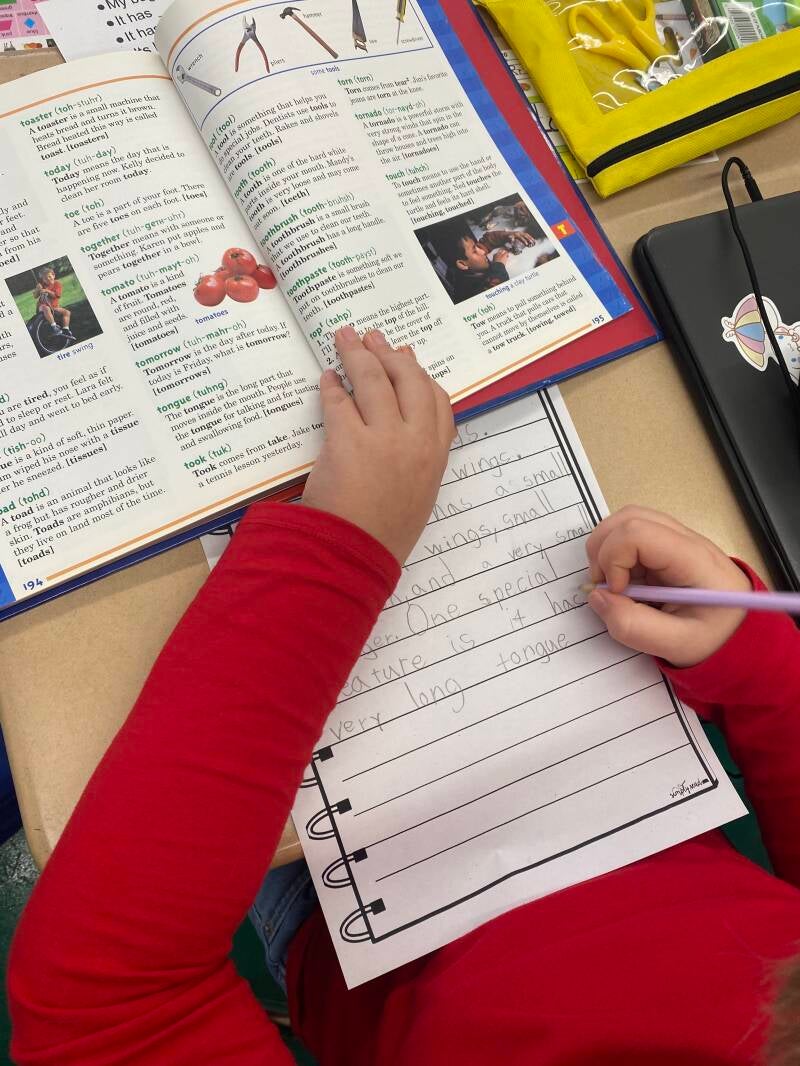
Earlier this week, I shared a picture of one of my second graders using a dictionary for the first time. At the time, I thought it was a sweet little classroom moment worth sharing. But as the week went on, I found myself reflecting on it a little more.
It all started during our informational writing unit. My students have been researching bugs and writing reports, learning how to organize facts, use text evidence, and include details that help their readers understand their topics.
One student was writing about a bug and wanted to write the word tongue. After sounding it out, this child decided to double-check the spelling by asking me to edit. I suggested they check their research text or ine if the dictionaries in our classroom library. They decided to try a dictionary.
There was something so lovely about watching a second grader independently recognize that a word didn't look quite right, seek out a resource, and take the time to check it. It was a small moment, but one filled with so much learning.
And then something else happened.
The other students noticed.
They were intrigued by the dictionary. They wanted to know how it worked, how to find words, and what else they could discover inside those pages. Before long, one child's decision to use a dictionary had sparked the curiosity of an entire classroom.
And now? Using a dictionary has become the new trend in Room 214!
I love that.
We spend so much time as teachers planning lessons, introducing strategies, creating anchor charts, and finding ways to make learning meaningful. We carefully think about the skills we want children to develop and the resources they need to get there. But sometimes, the most meaningful learning experiences aren't the ones we plan. They happen organically, when one child does something that catches the attention of another.
There are so many benefits to introducing dictionaries in second grade. Children begin to understand that they don't have to rely on someone else for every answer. They can use resources independently, strengthen spelling skills, build vocabulary, develop alphabetical awareness, and become more confident writers. More importantly, they begin to see themselves as problem-solvers who have tools available to help them.
But this week's little dictionary phenomenon reminded me of something else: children learn from one another in ways we sometimes underestimate.
One student's curiosity became another student's curiosity. One child's willingness to try something new made it feel exciting and accessible to everyone else. No elaborate lesson, no special incentive, no big announcement. Just a child checking the spelling of tongue while writing about a bug.
And suddenly, everyone wanted a turn.
As I think about my Educate the Heart philosophy, I am reminded that authentic learning is about more than the standards we teach or the skills we assess. It's also about creating an environment where curiosity is encouraged, independence is celebrated, and children feel empowered to take ownership of their learning.
This week, a dictionary became the most interesting thing in our classroom. And honestly, I couldn't be happier about that new trend.
Because if there's one thing I've learned after all these years in education, it's that sometimes the biggest learning moments begin with the smallest questions.
And sometimes, all it takes is one little word.
Tongue.
A little classroom reminder: Never underestimate the power of a child's curiosity. Sometimes the best lessons are the ones we never planned.
With gratitude,
Jennifer
Add comment
Comments