There are moments in the classroom when you can almost see the learning click. They may not be the biggest moments on the lesson plan, and they may not happen when you are standing at the front of the room explaining a new concept. Sometimes, they happen quietly, as a child takes something they have learned and begins to use it independently.
This week, I experienced one of those moments during our second-grade informational writing unit, and it reminded me why I love teaching young writers so much.
From Learning About Text Features to Using Them as Writers
Over the past several lessons, we have been exploring text features in informational texts as part of our Bugs in Their Ecosystems learning. We have been looking closely at how authors use headings, subheadings, captions, diagrams, and other features to help readers understand information.
We have asked questions, studied examples, and talked about why authors make particular choices. Why might an author include a diagram? How does a caption help us understand a picture? What information can a reader learn from a labeled illustration that might be harder to understand from words alone?
We have been learning that text features are not simply extra decorations on a page. They serve a purpose. They help readers locate information, understand important ideas, and learn something new.
Then came the moment that made me smile.
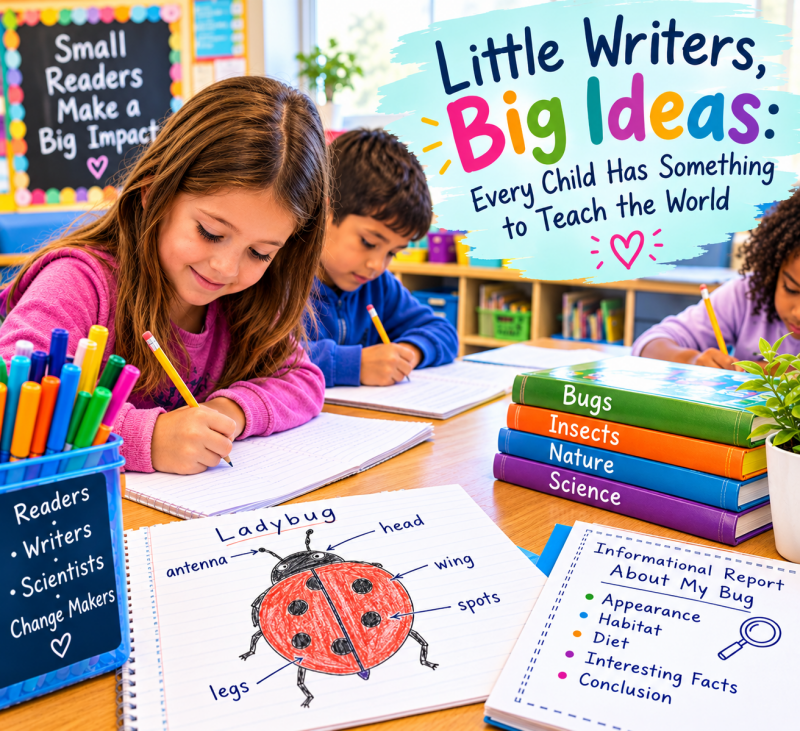
As one of my students worked on an informational report about a bug, the student included a diagram of the bug as part of the writing. It was such a simple choice, but it represented something much bigger. The student was taking what we had been learning about authors and text features and applying that knowledge as a writer.
This child was no longer just identifying a diagram in someone else's book. The child was becoming an author who understood why a diagram could help someone else learn.
And that is the kind of connection that makes teaching so rewarding.
The Writer in Me Sees the Story in Every Child
As a writer myself, one of my favorite parts of my job, and honestly, one of my favorite parts of life, is teaching children to share their stories.
I believe every child has something worth sharing. Every child has ideas, experiences, questions, observations, and discoveries that deserve to be heard. Sometimes, our job as educators is simply to help children recognize that their thoughts matter and give them the tools and confidence to communicate them.
When I think about writing, I often think about personal narratives and the importance of helping children tell their own stories. There is something beautiful about watching a young writer find the words to describe a meaningful experience, a special memory, or a moment that made them feel proud.
But informational writing offers another kind of possibility.
Through informational writing, children discover that they do not have to write only about themselves. They can write about the world around them. They can investigate a topic, gather facts, organize information, explain their thinking, and teach someone else something new.
They can become the experts.
Empowering Children to Be the Teachers
One of the most powerful things we can do as teachers is create opportunities for our students to see themselves as people who have knowledge worth sharing.
When a second grader writes a report about a bug, adds a diagram, labels important parts, and includes information to help a reader understand the topic, that child is doing much more than completing a writing assignment.
The child is making decisions.
The child is thinking about an audience.
The child is considering how words and visuals work together to communicate meaning.
Most importantly, the child is recognizing that learning can be shared.
I love the idea that our classroom can become a place where students are not always just the learners sitting in front of the teacher. They can also be the teachers who help others understand something new.
A diagram of a bug might seem like a small detail to an adult, but to a young writer, it can represent a significant step toward independence. It shows that the student is beginning to understand not only what a text feature is, but also how and why an author uses it.
That is the difference between memorizing a concept and applying it with purpose.
And it is a wonderful reminder that authentic learning happens when children have opportunities to use what they know.
Educating the Heart, One Writer at a Time
As I reflect on this moment, I am reminded that teaching writing is about so much more than conventions, organization, vocabulary, or meeting a standard.
Of course, those skills matter. We want our students to become capable readers and writers who can communicate their ideas clearly. We want them to recognize text features, understand informational texts, and use what they learn in their own work.
But we also want them to develop confidence.
We want them to believe their ideas are valuable. We want them to understand that their knowledge can help someone else. We want them to recognize that they have something meaningful to contribute to their classroom and to the world beyond it.
That is where academic learning and social-emotional learning meet.
When we give children opportunities to share what they know, we nurture their sense of competence and belonging. When we invite them to teach others, we help them see themselves as capable contributors. When we celebrate their efforts and the connections they make, we encourage them to keep taking risks, asking questions, and growing.
These are the little moments that stay with me.
As a former principal, a teacher, a mother, and a writer, I have come to appreciate how important it is to look beyond the finished product and notice the thinking behind it. A student's diagram is not simply a picture on a page. It can be evidence of a new understanding, a growing sense of independence, and the confidence to put learning into action.
And sometimes, the best part of a lesson is realizing that a child has taken what we taught and made it their own.
This week, a student used a diagram of a bug to teach a reader something new.
In that moment, I was reminded that our students are not just learning to write informational reports.
They are learning that their voices matter, their knowledge has value, and they have the power to teach others.
What a beautiful thing it is to be a teacher, helping young writers discover all the possibilities within themselves, one word, one illustration, and one meaningful connection at a time.
Every child has something to teach us. Sometimes, our greatest responsibility is helping them discover what they have to teach the world.
With gratitude,
Jennifer
Add comment
Comments