There are some weeks in the classroom when I find myself reflecting not only on what my students are learning, but also on the people, relationships, and little moments that make teaching such a meaningful part of my life. This was one of those weeks.
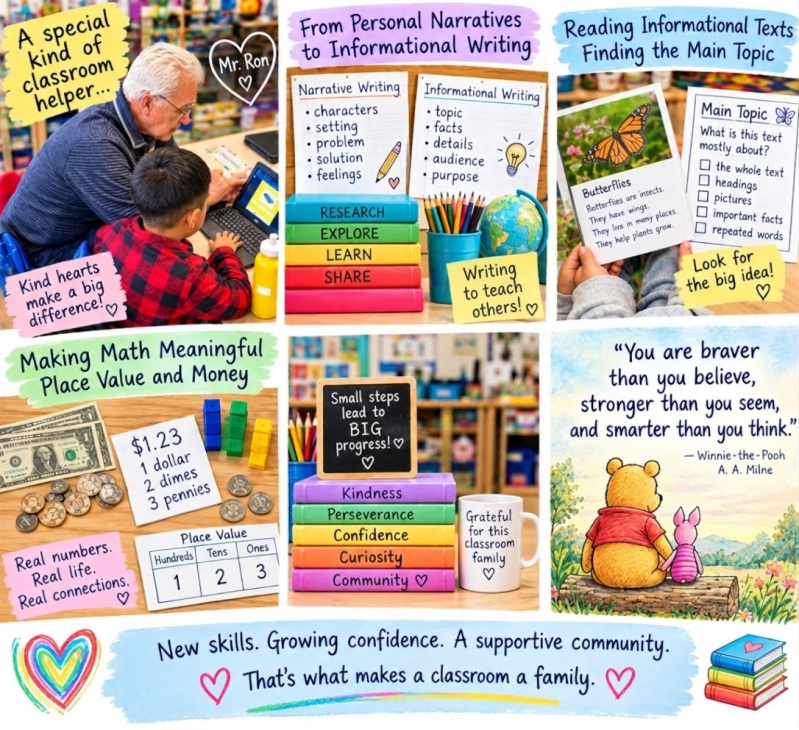
As we continue our journey together in second grade, our classroom is becoming a place where new skills are taking shape, confidence is growing, and learning is happening in ways that extend far beyond the pages of a workbook. And this week, we had something especially meaningful happening in our classroom: my dad, affectionately known as “Mr. Ron,” continued volunteering with us on Tuesday.
A Special Kind of Classroom Helper
Having my dad in the classroom is a gift that is difficult to put into words. Teaching has been such a significant part of my life, and having him share a little piece of that experience with me and my students makes it even more special.
The children get another caring adult in their classroom, someone who can encourage them, offer a helping hand, and remind them that there is a whole community of people cheering them on. I get to experience the joy of watching my dad become part of our classroom family.
After so many years in education, I have learned that children need more than good lessons and carefully planned activities. They need relationships. They need to feel seen, supported, and valued. They need adults who take an interest in their ideas and celebrate their efforts, even when the learning is challenging.
That is part of what makes a volunteer like Mr. Ron so valuable. His time reminds us that a classroom is not just a place where a teacher teaches and students learn. It is a community built by people who show up for one another.
And honestly, there is something especially lovely about seeing my dad become part of the little world I work so hard to create for my students. These are the moments I know I will remember long after the school year ends.
From Personal Narratives to Informational Writing
Academically, we are making an exciting shift in our reading and writing work. After spending time developing personal narratives, we are beginning to explore informational writing.
Our narrative work encouraged students to think about characters, settings, problems, solutions, and feelings. We practiced telling stories in a way that helped readers understand what happened and why it mattered. These lessons gave our young writers opportunities to share their experiences, develop their voices, and discover that their own stories are worth telling.
Now, we are turning our attention toward a different purpose for writing: teaching our readers something new.
Informational writing asks children to become observers, researchers, and teachers. Instead of telling a story about something that happened, they begin thinking about what they know, what they want others to understand, and how they can organize facts to communicate information clearly.
We are learning that writers need to think about their audience and purpose. We are also discovering that good informational writing begins with learning about a topic, noticing important details, and putting our thinking into words.
For second graders, this is a big step! It requires them to move beyond simply writing what comes to mind and begin making intentional decisions about the information they want to share.
We will continue building these skills one small step at a time, remembering that young writers need models, meaningful conversations, opportunities to practice, and plenty of encouragement along the way.
Reading Informational Texts: What Is the Main Topic?
Our reading instruction is supporting this new writing work beautifully.
As we read informational texts, we are practicing identifying the main topic. We are learning to ask ourselves, “What is this text mostly about?” and to notice how the details help us understand that topic.
This sounds simple, but it requires careful thinking. Young readers may remember one interesting fact or focus on a small detail without recognizing the bigger idea that connects everything together.
We are practicing looking at the text as a whole, paying attention to headings, illustrations, repeated words, and important facts. We are learning to distinguish between the main topic and the individual details that teach us more about it.
These reading conversations also help us build vocabulary, strengthen comprehension, and develop the language students will need when they begin writing informational paragraphs of their own.
I love when our reading and writing instruction connect in meaningful ways. When children read to learn about a topic, they begin to recognize the kinds of information writers include. When they write to teach others, they start to understand why readers need clear topics and supporting details.
Little by little, they are learning that reading and writing are not separate activities. They work together to help us make sense of the world and share what we discover.
Making Math Meaningful: Place Value and Money
In math, we began applying our understanding of place value to money.
Place value is such an important foundation in second grade. Children are learning that the position of a digit determines its value and that numbers can be understood by breaking them into smaller parts. Now, we are beginning to connect that thinking to a familiar, real-world context.
Money gives us opportunities to think about quantities, compare values, count collections, and explain our reasoning. As we work with dollar amounts, students can begin applying what they know about numbers to situations they might encounter outside of school.
These lessons also encourage mathematical conversation. How do we know which amount is greater? How can we represent a value in a different way? What strategies help us count accurately? How can we explain our thinking to someone else?
I always appreciate the moments when a concept begins to feel more concrete for a child. Mathematics becomes much more meaningful when students can connect what they are learning to experiences they recognize.
Of course, we will continue practicing and revisiting these concepts. Understanding place value takes time, and every opportunity to make a connection helps strengthen that foundation.
The Little Things That Become the Big Things
As I reflect on this week, I am reminded that teaching second grade is about balancing so many things at once. We are learning new academic skills, developing language, practicing independence, and building the social and emotional skills that help us become thoughtful members of a classroom community.
We are learning how to organize our writing, find the main topic in a text, and apply place value to money. But we are also learning how to listen, persevere, ask questions, accept help, and encourage one another.
Having Mr. Ron with us each week is a beautiful reminder that these lessons do not happen in isolation. Children learn from the books we read, the problems we solve, the conversations we have, and the people who take the time to be part of their lives.
It brings me back to one of my favorite ideas from children's literature, beautifully expressed in Winnie-the-Pooh by A. A. Milne:
“You are braver than you believe, stronger than you seem, and smarter than you think.”
I love this reminder for second graders because learning often requires children to do things they are not yet sure they can do. Writing an informational paragraph may feel overwhelming. Finding the main topic may take several attempts. Understanding place value and applying it to money may require a little extra practice.
Our job is to help children believe they can keep trying.
And perhaps the same reminder applies to the adults in their lives, too. We are all learning, growing, and discovering new ways to make a difference. Sometimes that happens through a carefully planned lesson. Sometimes it happens when we sit beside a child who needs help. And sometimes it happens when a grandparent walks into a classroom, gives his time, and becomes part of a community of learners.
As another week comes to a close, I am grateful for the progress my students are making, the questions they continue to ask, and the small moments that make our classroom feel like a family.
I am grateful for the chance to teach, for the opportunity to keep learning alongside my students, and for the people who remind us that education is ultimately about so much more than academics.
It is about helping children discover what they are capable of becoming.
And that is a lesson worth carrying with us every day.
With gratitude,
Jennifer
Add comment
Comments