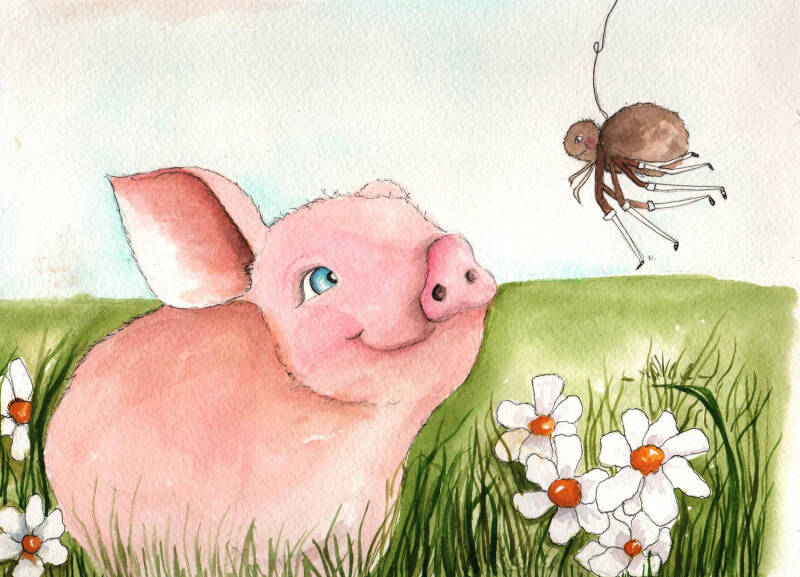
“Never hurry and never worry.”
— Charlotte's Web
This week in our MLL kindergarten classroom, those simple words from Charlotte felt especially meaningful.
In a world that often pushes children to move faster, answer quicker, and grow up sooner, kindergarten reminds me daily that learning has its own rhythm. Some children bloom loudly and confidently. Others unfold slowly, carefully, like a spider spinning a web one strand at a time. Both are beautiful. Both matter.
As we dove into our spider unit this week, the classroom buzzed with curiosity. Tiny hands pointed excitedly at diagrams of spider bodies while dramatic gasps filled the room every time we discovered another fascinating fact. One student looked at a close-up picture of a web and whispered, “It looks like tiny strings of magic.” Honestly, that description felt more accurate than anything a textbook could offer.
We read several spider-themed stories and practiced comparing characters and events across texts. The children noticed how different spiders behaved in different books. Some spiders were helpful. Some were lonely. Some were funny, and some were misunderstood. During one discussion, a student explained, “Charlotte helps Wilbur because she is kind, but the spider in the other story scares everybody first.” That small observation carried such big thinking — comparing not just events, but motivations and emotions.
For multilingual learners, these conversations are powerful. Language grows when children have authentic reasons to use it. Sentence frames like “Both characters…” and “One difference is…” became bridges that helped students share ideas with confidence. I watched children who once answered with single words begin speaking in full comparisons. Slowly. Carefully. Courageously.
And then there were the teen numbers.
Teen numbers can feel wonderfully messy in kindergarten. Eleven, twelve, thirteen — those tricky numbers that refuse to follow predictable patterns. We used cubes, ten frames, drawings, and movement to build understanding that teen numbers are really “one ten and some more.” One child proudly announced, “Fourteen is like hiding a ten inside!” I wanted to write that quote down forever.
What struck me most this week was how much learning mirrors the work of a spider.
Spiders do not rush their webs. They build patiently, thread by thread. If the web breaks, they rebuild. If the wind interferes, they begin again. There is persistence in that process. Trust in it.
Teaching kindergarten — especially in an inner-city multilingual classroom — often asks for that same patience. Progress may not always look dramatic. Sometimes it is a child finally volunteering to speak during read-aloud. Sometimes it is correctly identifying the difference between 16 and 61. Sometimes it is using the word “character” naturally in conversation for the very first time.
Small strands become strong webs over time.
This week reminded me that meaningful learning rarely happens in a hurry. It happens through repetition, wonder, conversation, mistakes, laughter, and trust.
So as we ended the week surrounded by spider books, counting cubes, and carefully crafted comparison charts, I found myself holding tightly to Charlotte’s gentle wisdom:
Never hurry. Never worry.
The children are growing exactly as they should.
Thank you for visiting the blog today and taking the time to read this post. I hope you found it worthwhile.
Best,
Jennifer
Add comment
Comments